
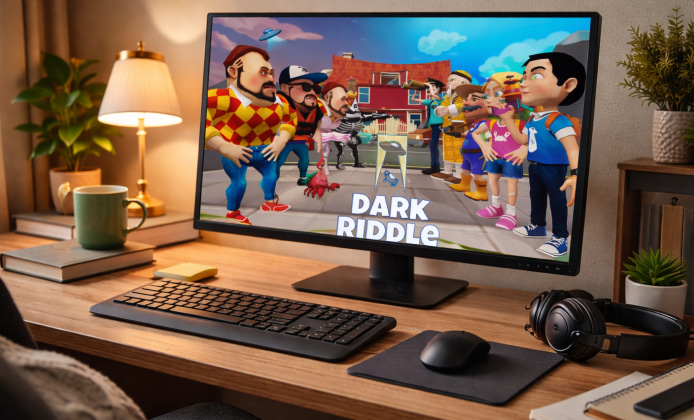
Dark Riddle is built around curiosity: you explore a quirky neighborhood, sneak into suspicious places, and connect tiny clues into big solutions. This guide focuses on practical habits that help you progress smoothly, avoid wasted backtracking, and keep your runs efficient without spoiling every surprise.
Before You Start: Set Yourself Up for Clean Progress
Early minutes decide whether your session feels focused or messy. Take a moment to stabilize your routine:
- Play with sound on when possible, because audio cues often signal hazards or NPC movement.
- Keep your camera sensitivity comfortable so you can scan rooms without over-rotating.
- When you pick up a new item, pause and ask: “What kind of lock, switch, or device could this logically fit?”
For newcomers, the best mindset is treating each location like a mini escape room: observe first, interact second, and only then commit to risky actions.
Core Loop: Explore, Collect, Test, and Document
Dark Riddle rewards players who document what they learn. You do not need external notes, but you should build a “mental map” of three things: locked doors, interactive props, and recurring NPC routes.
To keep the loop tight, follow this pattern:
- Do a fast sweep of the area to locate exits, hiding spots, and interactable objects.
- Collect anything portable that looks unique, especially items with odd shapes or icons.
- Test one hypothesis at a time (one key, one panel, one switch), then reset safely if it fails.
- Return later with a better toolset instead of forcing a solution with random attempts.
To get comfortable quickly, many players treat Dark Riddle play as a short daily puzzle workout after dinner.
Stealth and Safety: Moving Like You Belong There
The neighbor’s behavior can feel unpredictable until you pay attention to patterns. In most situations, you can avoid trouble by staying deliberate:
- Use corners and furniture to break line-of-sight rather than sprinting in open space.
- Close doors behind you when possible, since it reduces surprise encounters.
- When you must run, run with a destination in mind (a hiding spot or an exit), not just “away.”
“The fastest way to solve a puzzle is to stay calm long enough to notice what the game is already telling you.”
If you want a smoother learning curve, a gentle approach like Dark Riddle free-to-play can help you practice risk-free routes without pressure.
Clue Reading: How to Spot What Actually Matters
Not every object is important, and that is where players lose time. Train your eye to prioritize:
- Distinct visuals: items that look different from the environment’s normal clutter.
- Repetition: symbols that appear in multiple places (posters, screens, locks).
- Proximity: tools that appear near a mechanism they likely affect.
When you encounter a locked interaction, step back and scan the room again. Often, the solution is nearby, but it is disguised as decoration until you learn the game’s visual language.
Common Puzzle Types and Reliable Tactics
Most progress blockers fall into a few predictable categories. Use the matching tactic instead of improvising blindly:
| Puzzle Type | Best Tactic | Common Mistake |
|---|---|---|
| Keyed locks | Check nearby drawers, shelves, and small containers first | Leaving the area too early and forgetting the lock’s location |
| Switches and panels | Look for wires, symbols, or a device that “should” react | Flipping everything quickly without observing the environment changes |
| Fetch and combine | Collect all parts first, then revisit the combination point | Trying to combine items at random locations |
| Timed stealth moments | Plan your route, identify hiding spots, then execute once | Rushing in without knowing where to retreat |
Route Planning: A Simple “Three-Zone” Method
To reduce backtracking, divide your current chapter into three zones:
- Home base: the safest area where you can regroup and check inventory decisions.
- Target zone: where the main objective is, usually with higher risk.
- Supply zone: where you repeatedly find tools, clues, and secondary items.
Run a loop between supply and target, and return to base only when you’ve confirmed a meaningful change. This keeps your sessions short and productive.
When you practice this loop consistently, it feels natural to play Dark Riddle with fewer unnecessary trips across the map.
Online Sessions: Keeping Them Smooth and Focused
If you are playing in a context where you jump in and out quickly, your goal is minimizing “re-learning time.” Create a repeatable warm-up:
- Spend one minute checking the last locked door or device you remember.
- Spend one minute scanning inventory and matching items to mechanisms.
- Spend one minute doing a safe sweep for newly revealed interactions.
For players who like short bursts, a format such as Dark Riddle online play can work well when you stick to one objective per session.
How to Avoid Getting Stuck
When progress halts, it is rarely because you missed something huge; it is usually because you missed something small. Use this recovery checklist:
- Revisit every place where you saw a lock, keypad, odd symbol, or blocked path.
- Interact with suspicious “decor” objects at least once (posters, monitors, boxes).
- Consider whether your newest item is meant for a previous area, not the current one.
- Do one slow sweep with your camera aimed slightly downward to spot tiny interactables.
If you are learning without spending, an option like Dark Riddle online free-to-play can still be enjoyable when you focus on consistent clue tracking.
Mini Strategy: Make Every Attempt Count
Instead of repeating the same failure, change one variable each attempt. For example, if you keep getting caught:
- Change your entry angle.
- Wait for a different NPC timing window.
- Choose a closer hiding spot.
- Grab the objective last, so you can escape immediately.
With that mindset, you will be ready whenever you decide to play Dark Riddle again tomorrow morning.
Quick FAQ
- How do I progress faster without spoilers? Focus on mapping locks to item types, and commit to one hypothesis at a time.
- What should I do if I keep missing a clue? Return to the last “new” location you unlocked and scan for symbols, panels, and containers.
- Is there a safe way to test ideas? Yes: plan a retreat route first, then test your interaction and exit immediately if things go wrong.
For a low-pressure start, many beginners explore with Dark Riddle for free game play while building confidence and routine.


 Explore Dark Riddle Game: Clues, Chaos, and Clever Puzzles
 Dark Riddle Play Guide: How to Outsmart the Neighbor and Finish Puzzles Faster
 Dark Riddle on PC: How to Play Comfortably, Safely, and Smoothly
 Dark Riddle APK Guide: Safe Install, Smooth Performance, and Smart Tips
 What Is Dark Riddle and How to Play?
 Best Games Similar to Dark Riddle